
Outside work
Full House Re-Render in Southport
A whole house taken back to a sound wall or rendered over where the old finish is still solid, then every elevation finished in one silicone system so the house matches on all four sides.
- 15 years on the tools
- Based in Birkdale
- 4.7 on Google
- Written price after a look at the walls
What customers said about this work
Very pleased with the work Anthony did for me recently. First time I've used MyBuilder but Anthony was absolutely spot-on. Quick to respond throughout, good estimates, and happy to explain options and process for the job. Work was conducted to a high professional standard, to time, tidy and with no fuss. The wall and ceiling areas I needed plastering were a complete mess beforehand following a rewire but you'd never guess now, and they look even better than I was expecting. Thanks again!
 MyBuilder
Anthony did an outstanding job pebble-dashing our entire house. It was a challenging project but he handled every aspect with professionalism and care—nothing was ever too much trouble. He worked incredibly hard and maintained a clean and tidy worksite throughout. We couldn’t be happier with the result.
MyBuilderAnthony was professional in his work and clean and tidy, was made up with the finished work.
MyBuilderFull house re-rendering
What a full re-render involves, in order
- 1. Survey, and what is actually under the old render
The wall gets tapped over, corner to corner. Hollow render sounds completely different to render that is still stuck to the wall, and that one test decides most of the job. We also look at what is causing the failure: a blocked gutter, a bridged damp course or a cracked cill will do the same thing to new render as it did to the old.
- 2. Strip or overcoat, decided wall by wall
Not a whole-house decision. One elevation can be sound enough to render over while the gable that takes the weather has to come off. You get told which is which and why, before the price is written.
- 3. Scaffold
Anything above single storey needs it, and it is priced in the written estimate rather than added later. It usually goes up a day or two before the first coat and stays until the finish has cured.
- 4. Basecoat and alkali-resistant mesh
The mesh is bedded into the basecoat wet, not laid on and covered after, so it ends up in the middle of the coat where it does its job. That is what stops the hairline cracking that shows up on a cheap render a year or two in.
- 5. Beads and detailing
Stop beads, bell casts, corner beads and movement joints, and the reveals, cills, plinths and canopies worked round properly. On a whole house this is most of the skill and most of the time.
- 6. Silicone top coat
Through-coloured and breathable, applied and floated to an even texture, working one elevation at a time so there is no join stopped halfway across a wall.
- 7. Clean down
Masking off, scaffold away, paths and windows washed down, and everything that came out of the borders put back.
Days on site: as a rough guide, a typical three-bed semi is usually a one to two week job once the scaffold is up, allowing curing time between the basecoat and the top coat. That is the same figure given on the silicone renderingPlastering page, because it is the same system going on.
The decision that sets the price
Strip it off, or render over it
It has to come off when
- It sounds hollow when it is tapped, anywhere across the wall.
- It is cracked through, lifting at the edges or blown around the openings.
- It is a painted finish that has been painted again and again, so the new system would be keyed to paint rather than to the wall.
- It is sand and cement on a solid wall that has been holding water in.
- The failure has a cause behind it, like a bridged damp course, that has to be reached and fixed first.
It can stay when
- It rings solid over the whole elevation and is well keyed to the substrate.
- Pebbledash that is sound, which can be overclad rather than hacked off.
- Cracking is limited to a few places that can be cut out and made good.
- It is dry, and nothing on the wall is putting water into it.
Overcoating a sound wall saves the strip, the skip and a chunk of the labour. Putting a new system over a failing one buys a couple of years and then lets go all at once, with the new render taking the old off with it.
What moves the number
What affects the price of a full re-render
- Wall area, not the number of bedrooms. A three-bed semi with a big gable can have more wall than a four-bed detached.
- Whether the old render comes off. Stripping, disposal and making the wall good is labour, skip and time.
- Access and scaffold. Storeys, a conservatory in the way, a narrow side path or a boundary you cannot scaffold over.
- Insulation. Boards on the wall are a different system to render straight onto a substrate.
- Detailing. Bays, canopies, arched heads, quoins, plinths, band courses and second colours all take time.
- What has to be fixed first. Gutters, cills, a damp course being bridged. Rendering over a defect hides it, it does not solve it.
No square metre price is published here, because one that ignored all of the above would be a guess with a number attached. What the parts cost and what moves them is set out in the Southport rendering cost guide, and the written estimate comes after a look at the actual walls.
Whole houses, done
Real results
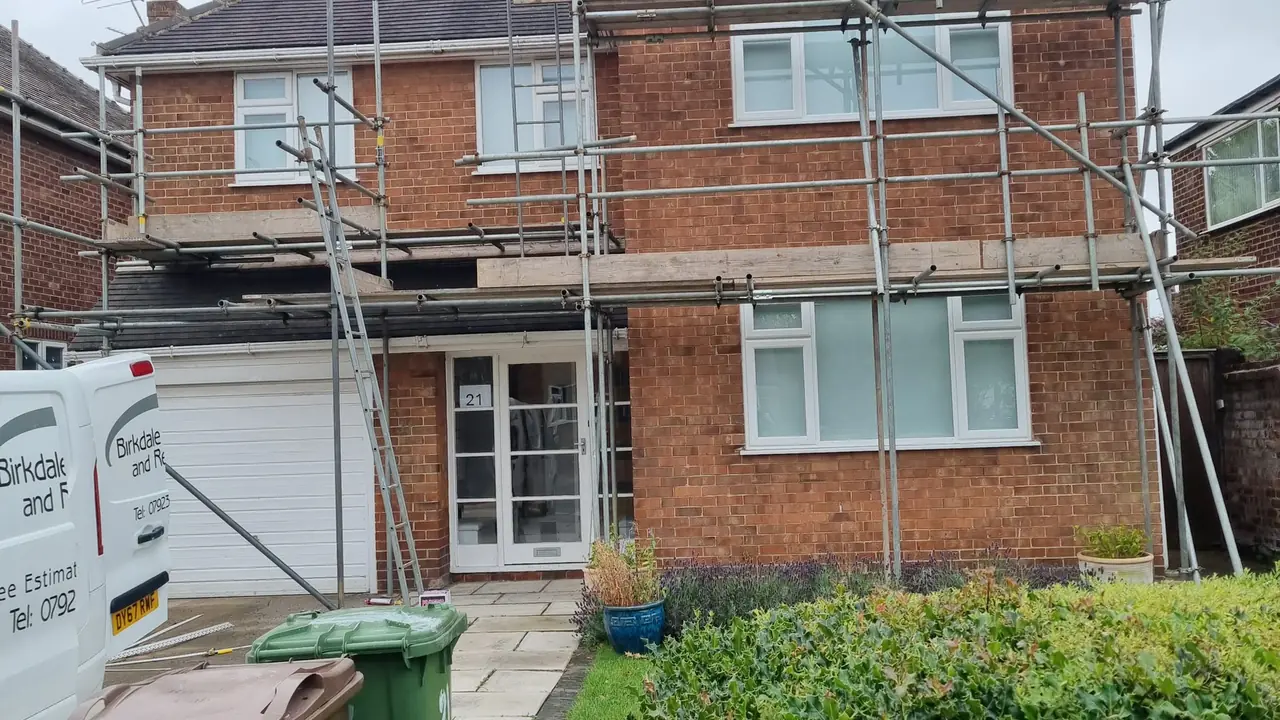
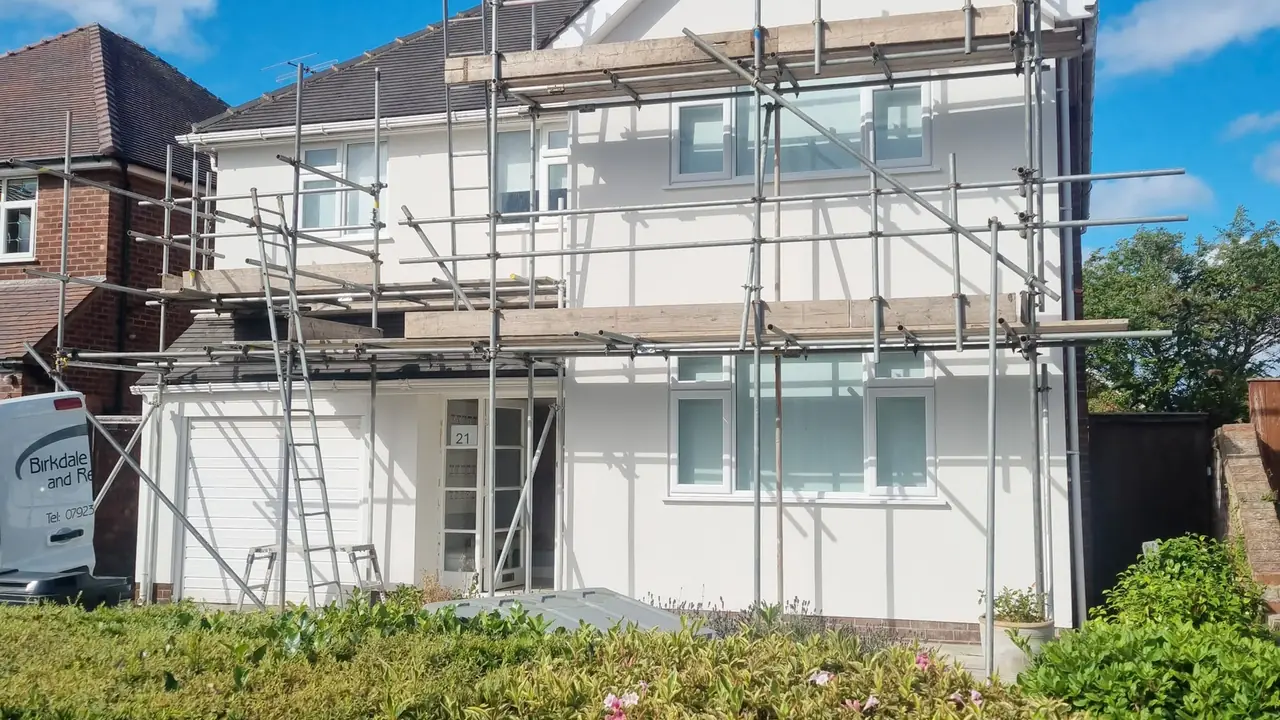
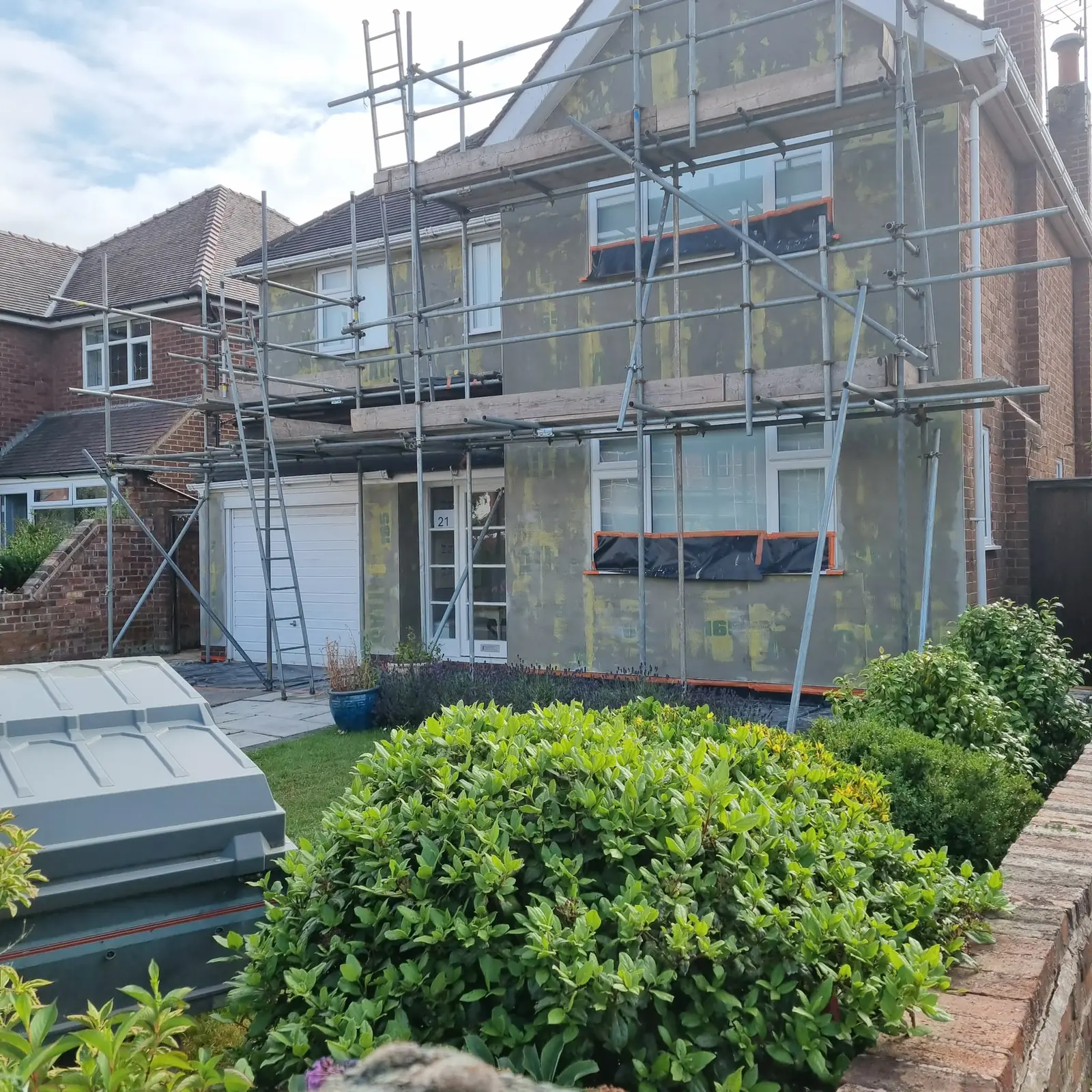
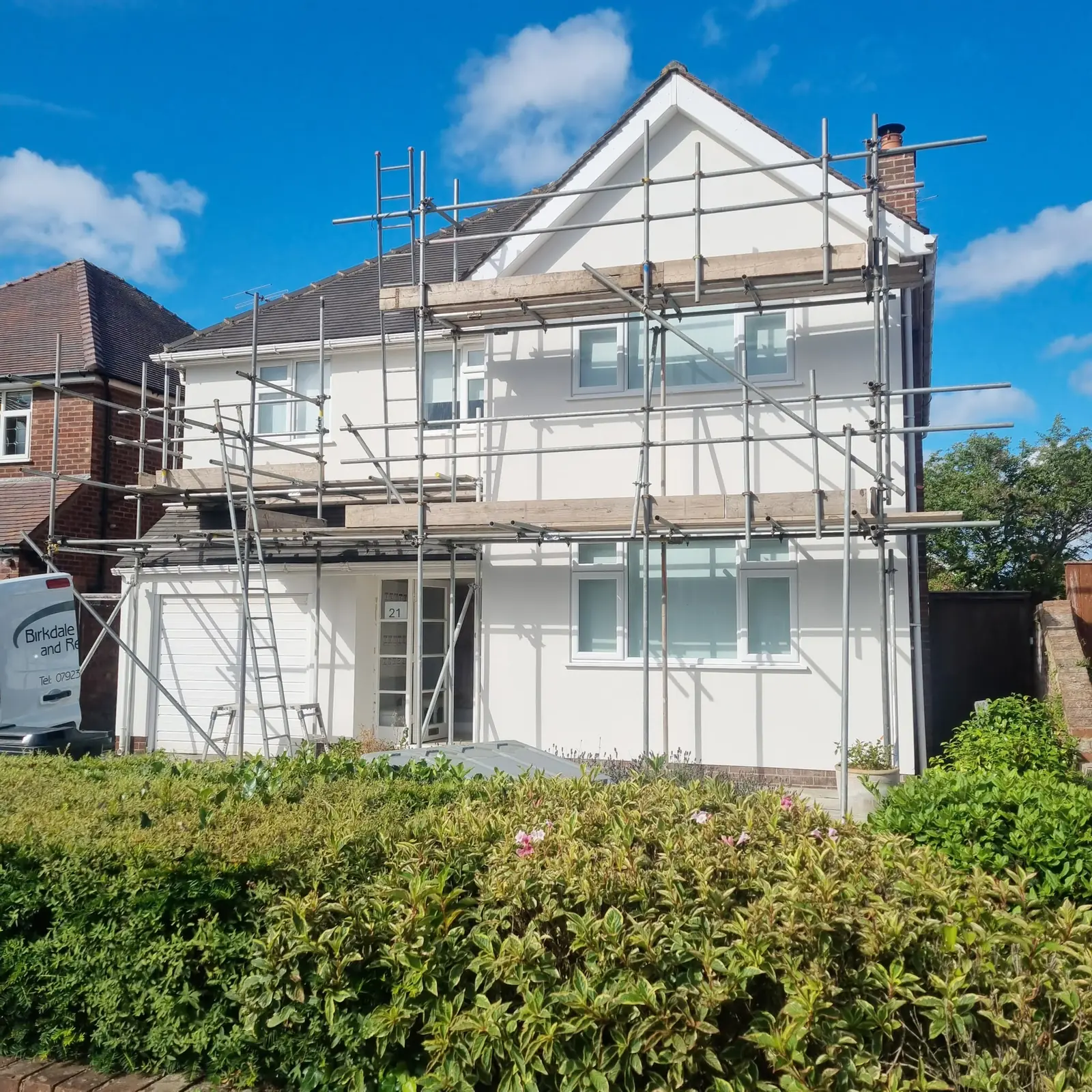 BirkdaleBare red brick detached, insulation boards and basecoat across every elevation, finished in white silicone.
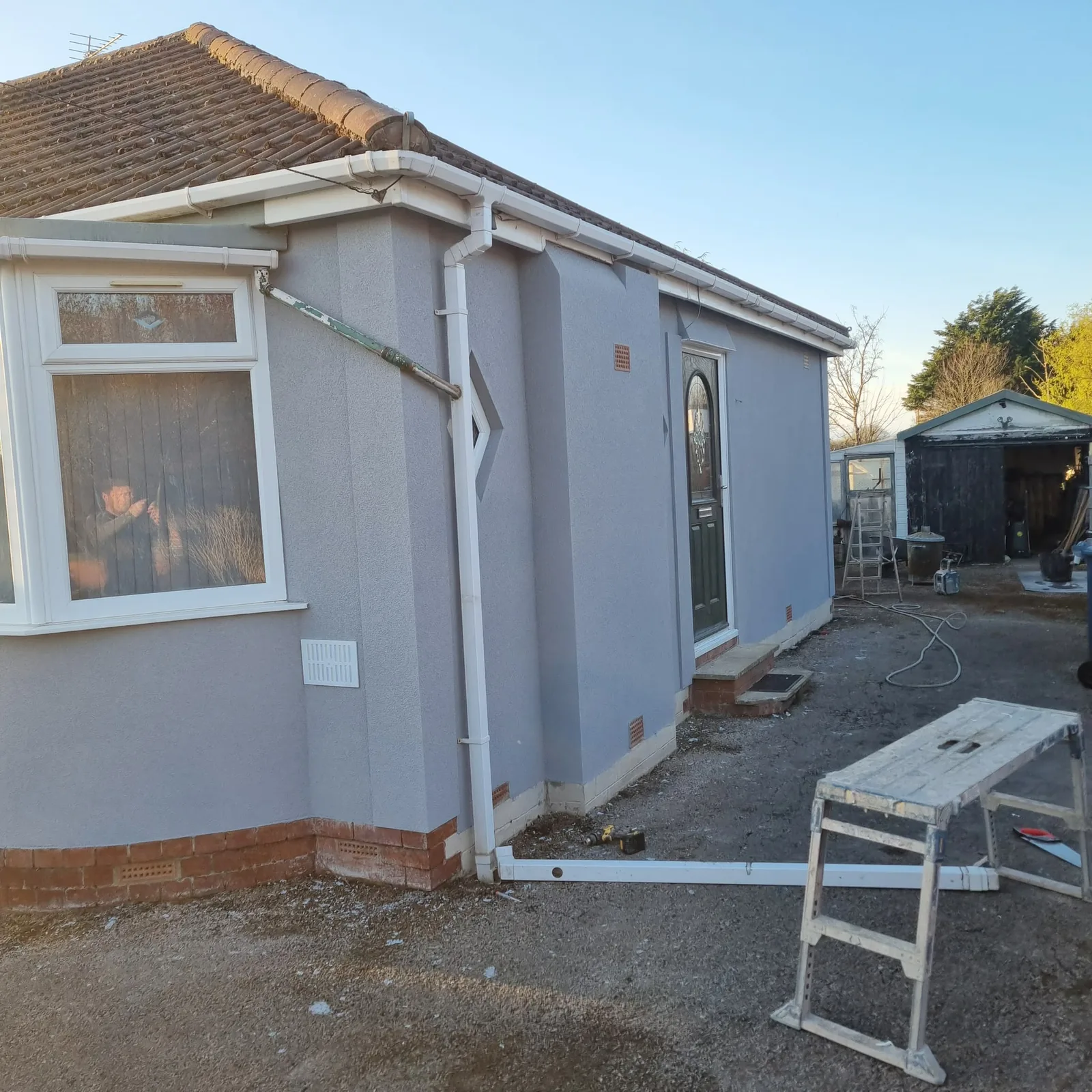 MaghullThe old painted finish stripped back to a sound substrate first, then re-rendered in grey through-colour.
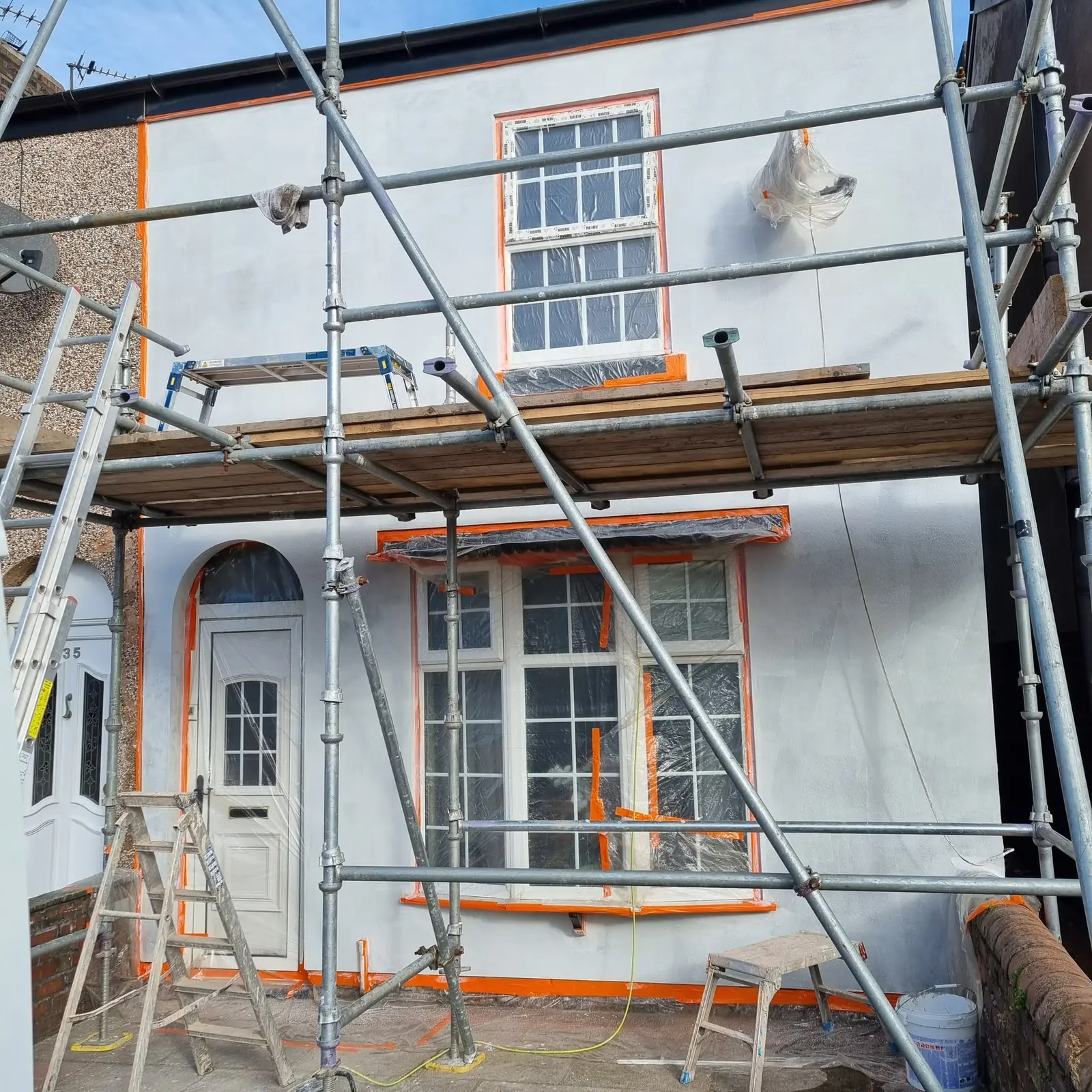 ChurchtownTired grey painted render taken off a terrace front and replaced, openings masked and beaded as it went on.
Frequently asked questions
Questions people ask about a full re-render
If the answer you want is not here, ring and ask.
How long does a full house re-render take?
As a rough guide, a typical three-bed semi is usually a one to two week job once the scaffold is up, because the basecoat has to cure before the top coat goes on. A bungalow is quicker. A large detached with bays, canopies and a lot of detailing takes longer, and a wet fortnight moves everything, which is why the estimate gives you a window rather than a date we cannot keep.
Can I stay in the house while it is re-rendered?
Yes. It is all outside work, so nothing comes off your walls indoors and the water and heating stay on. Windows and doors on whichever elevation is being worked get masked for that part of the job, so a room or two loses its light for a day at a time, and the scaffold is up for the length of the job. Bins, cars and anything precious in the borders are worth moving before the scaffold arrives.
Do I need planning permission to render my house?
For most houses, no, because rendering an existing wall is normally permitted development. A listed building, a house in a conservation area or a property with a planning condition on its external finish is a different matter, and that is a question for Sefton Council or your own local authority before anything is booked. We will not give you a planning ruling, and nobody on a scaffold should.
What colours can a full re-render be finished in?
Silicone render is through-coloured, so the colour is in the material rather than painted on the face of it. Whites, off-whites and greys are what most houses round here go for, often with a darker plinth, band or reveal detail in a second colour. The colour chart comes to the estimate so you can hold it against the brick, the roof and the frames in daylight, which is the only way to judge it.
How long does silicone render last on a whole house?
On a sound, properly prepared wall, a correctly installed silicone system should go 20 years or more before it needs anything more than a wash down. There is no paint film on it to blister or fade, which is what usually dates a rendered house five or six years after it is painted. What shortens that is skipping the preparation underneath, which is the part of a re-render nobody can see once it is finished.
Get a price for a full re-render
Tell us what is on the walls now and how much of the house you are thinking about, and you get a written estimate after a look at it, with the scaffold and the preparation priced in.
About full house re-rendering in Southport
Most of the whole-house work round here is a house that was rendered once already and has reached the end of it. Wind off the Irish Sea carries salt and water onto west and south-west elevations day after day, and an old sand and cement coat with a few layers of masonry paint on it holds that water against the wall instead of letting it go. The gable goes first, then the chimney breast, then the render starts sounding hollow in patches and someone paints it again.
Doing the whole house at once, rather than one elevation at a time, is what keeps it looking like one house: the same batch, the same texture and the same colour on all four sides, with the corners and the details worked to match. It also means the prep is judged across the whole building, so the sound walls get overcoated and the failed ones get stripped, instead of one decision being applied to everything.
We work across Southport, the Sefton coast, Liverpool and West Lancashire. If part of the house is what you need rather than all of it, that is the silicone renderingPlastering and external renderingPebbledash RemovalRender Repairs pages.